The Business Changes as the Entrepreneur Changes.
Every business has numbers, systems, customers, employees, assets, and liabilities.
But behind every one of them is a person making decisions.
That person brings ambition, experience, intuition, confidence, fear, habits, assumptions, and emotion to the table. Those qualities can be responsible for creating an extraordinary business.
They can also get in the way of building one.
That realization is at the heart of Cognitive Business Consulting.
Sometimes our work involves formal cognitive coaching. More often, cognitive principles simply become part of how we advise an entrepreneur—how we ask questions, listen to the language being used, challenge assumptions, evaluate risk, and help separate what someone feels about the business from what the evidence actually tells us.
Because sometimes the most important thing we can change in a business isn’t the business.
It’s the way we’re thinking about it.
WHY “COGNITIVE” BUSINESS CONSULTING?
Founder Mike Donnelly’s background in cognitive behavioral coaching introduced a different dimension to decades of experience in finance, investment banking, consulting, and business operations.
The connection became increasingly apparent.
The same thinking patterns that affect decisions in everyday life appear constantly in business.
An entrepreneur might say:
“Everybody loves this idea.”
“This will never work.”
“We always do it this way.”
“Nobody else can do what I do.”
“If we lose this customer, we’re finished.”
“This is definitely going to be huge.”
Words like always, never, everybody, nobody, definitely, impossible, guaranteed can tell us something.
They don’t necessarily mean the underlying idea is wrong. They tell us it may be time to slow down and examine the evidence.
What do we actually know?
What are we assuming?
What evidence supports the conclusion?
What evidence contradicts it?
What other explanations are possible?
And what would we decide if we removed some of the emotion from the equation?
That isn’t negative thinking.
It’s clearer thinking.
ENTREPRENEURS ARE DIFFERENT. THAT’S THE POINT.
It takes a particular willingness to accept uncertainty to become an entrepreneur.
You invest before knowing the outcome. You hire before all the revenue arrives. You pursue opportunities other people may not see. You put your reputation, capital, and sometimes your livelihood behind an idea because you believe you can make it work.
We don’t want to eliminate that instinct.
We want to harness it.
The confidence that allows an entrepreneur to take a calculated risk can become overconfidence.
Persistence can become an unwillingness to change course.
Optimism can become unrealistic forecasting.
Attention to detail can become an inability to delegate.
Independence can become isolation.
And fear of failure can sometimes keep an owner committed to yesterday’s decision long after the facts have changed.
Good coaching isn’t about making entrepreneurs less entrepreneurial.
It’s about helping them recognize when their greatest strengths may also be influencing their judgment.
KNOW WHEN TO HOLD ’EM. KNOW WHEN TO FOLD ’EM.
Kenny Rogers gave entrepreneurs a surprisingly useful piece of advice in The Gambler: there are times to hold and times to fold.
Business owners make versions of that decision constantly.
Do we invest more—or preserve capital?
Hire—or wait?
Expand—or consolidate?
Keep trying—or change direction?
Borrow—or bootstrap?
Acquire—or build?
Hold—or sell?
The answer isn’t always the conservative choice, and it isn’t always the aggressive one.
The objective is to make a rational, informed decision while recognizing that risk can never be eliminated from entrepreneurship.
CBC helps bring another voice to that conversation—one that can challenge the decision without challenging the person making it.
That distinction matters.
THE FIVE STAGES OF BUSINESS CHANGE
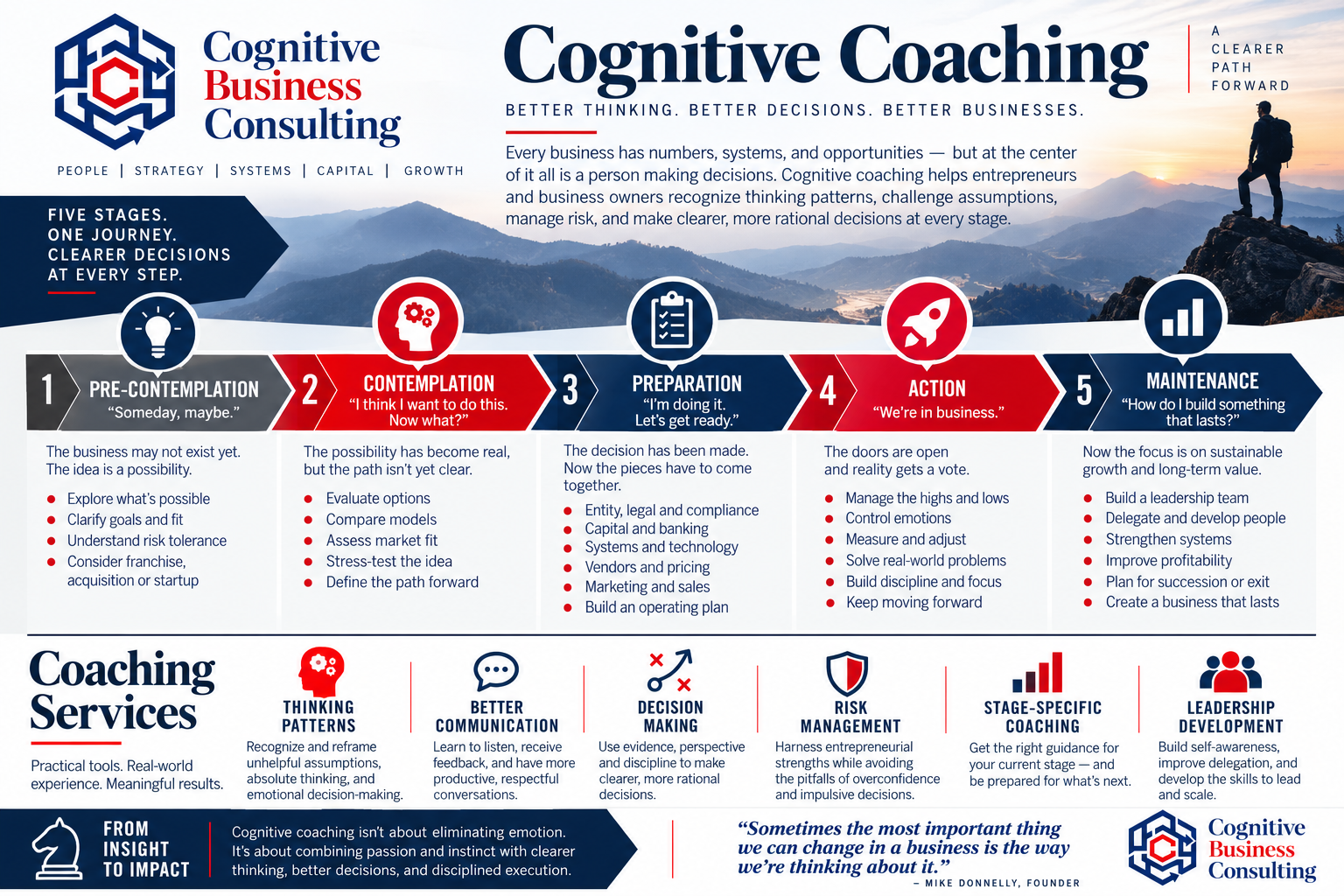
One of the most powerful connections behind our approach came from recognizing similarities between the Stages of Change model used in behavioral change and the journey of an entrepreneur.
Businesses don’t simply get bigger.
Their owners move through stages with them.
Each stage presents different questions, risks, decisions, and psychological challenges.
Understanding the stage you’re in can help you prepare for the one that’s coming.
“Someday, maybe.”
The business may not even exist yet.
Perhaps you’ve spent a career working for someone else. You’re approaching retirement but aren’t ready to stop working. You’ve always thought about owning a company. You’ve wondered about buying a franchise. Or you’ve identified an opportunity but haven’t seriously considered yourself an entrepreneur.
At this stage, the idea is still somewhere between curiosity and possibility.
This is where exploration begins.
What do you want your next chapter to look like?
What are you good at?
How much risk are you willing to accept?
What kind of business fits your financial objectives, experience, lifestyle, and temperament?
Sometimes the first step isn’t creating a business plan.
It’s recognizing that becoming a business owner is actually an option.
“I think I want to do this. Now what?”
The possibility has become real.
You can picture yourself owning a business, but the path isn’t yet clear.
Start something from scratch?
Buy an existing business?
Purchase a franchise?
Join a partner?
Keep your current career while developing something on the side?
This is a stage where enthusiasm can easily outrun analysis.
CBC can help turn the conversation from “I want to own a business” into “What business should I own, why does it make sense, and what would have to be true for it to succeed?”
“I’m doing it. Let’s get ready.”
The decision has been made.
Now the idea has to become an enterprise.
Entity formation. Capital. Banking. Accounting. Insurance. Compliance. Technology. Vendors. Pricing. Marketing. Sales processes. Employees. Contracts. Locations. Equipment.
The entrepreneur suddenly discovers there are a hundred decisions between having an idea and opening the doors.
This is where preparation can prevent expensive mistakes later.
The objective isn’t perfection.
It’s entering the market with enough structure to give the business—and the entrepreneur—a reasonable chance to succeed.
“We’re in business.”
The doors are open.
Now reality gets a vote.
Customers behave differently than the spreadsheet predicted. Employees surprise you. Competitors react. Marketing works—or doesn’t. Cash flow becomes real. Problems arrive at inconvenient times.
There are great days when entrepreneurship feels like the best decision you’ve ever made.
There are other days when you wonder what you were thinking.
Both can distort judgment.
The challenge during the Action stage is learning to ride the highs and lows without allowing either one to dictate strategy.
A terrible Tuesday doesn’t necessarily mean the strategy is broken.
And one extraordinary month doesn’t necessarily mean you’ve conquered the market.
“How do I build something that doesn’t depend entirely on me?”
Success creates its own challenge.
The entrepreneur who built the business can eventually become the person preventing it from growing.
Not intentionally.
You simply become accustomed to being the person who knows everything, approves everything, solves everything, and protects everything.
Eventually that stops working.
Maintenance isn’t standing still.
It’s learning to grow at a sustainable pace, developing managers, building a leadership team, creating systems, delegating authority, establishing accountability, strengthening the balance sheet, and allowing other capable people to take ownership.
The question gradually changes from:
“How do I run my business?” to:
“How do I build a business that can run without me?” And eventually:
“What do I want this business to become—and how do I realize the value I’ve created?”
That may mean succession.
It may mean acquisition.
It may mean franchising.
It may mean bringing in new leadership.
Or it may mean preparing for an eventual exit.
THE NEXT STAGE CHANGES THE QUESTIONS
That’s where the five-stage framework becomes especially useful.
The right advice for an entrepreneur in Contemplation may be completely wrong for someone in Maintenance.
A startup may appropriately take risks an established company shouldn’t.
A founder in the Action stage may need to retain control of certain decisions. A founder in Maintenance may desperately need to relinquish them.
Capital that makes sense during rapid expansion may make no sense when preparing for an exit.
The people who got you here may—or may not—be the people who can get you there.
Every stage requires a different version of the business. And often, a different version of the entrepreneur.
Cognitive coaching is a transformative approach designed to empower individuals and organizations by reshaping thought patterns and enhancing emotional resilience. Our personalized cognitive behavioral coaching aims to reshape individuals’ lives, turning every negative emotion and thought into a positive one for optimal outcomes. Our unique approach combines Cognitive Behavioral Therapy techniques with real-world applications, providing customized support for personal and professional growth.
Our Clients – B2C and B2B
Mike Donnelly caters to both B2C and B2B clients.
Cognitive Therapy for B2B Clients
From anger management therapy to cognitive behavioral therapy short term, our solutions for businesses equip organizations with tools to cultivate a productive, resilient, and positive workplace environment. These services enhance employees’ ability to manage stress, improve performance, and contribute to a collaborative and adaptable company culture.
We offer:
• Enterprise CBT Training
We offer custom-designed CBT programs to help employees at all levels build self-awareness, manage stress, and make informed decisions. These programs include workshops, team sessions, and individual support to boost productivity and reduce burnout.
• CBT for Human Resources
This specialized training supports HR teams in guiding employees through behavior challenges and policy compliance. It provides HR with skills to promote positive behavioral change and emotional intelligence, promoting a balanced and inclusive workplace.
• Coach the Coaches
For organizations with an internal coaching framework, our Coach the Coaches program empowers leaders and coaches to integrate CBT techniques into their coaching practices. This boosts their effectiveness in handling workplace challenges, from performance issues to conflict resolution.
Therapy for B2C Clients
This emphasizes a transformative approach, helping clients from diverse backgrounds—executives, athletes, and personal growth seekers—develop sustainable mental resilience and self-coaching skills for better life outcomes.
• Personalized Coaching
Each client receives a customized coaching plan that addresses their specific struggles, whether it’s anxiety, depression, or life transitions. This tailored approach encourages meaningful progress and self-discovery.
• Support for Life Changes
Our coaching is particularly beneficial for individuals navigating significant life changes, such as career transitions or personal challenges, helping them develop resilience and adaptability.
• Goal Setting and Achievement
Through our coaching, clients set achievable goals and receive ongoing support to reach them. This process enhances motivation and promotes a sense of accomplishment.
Our Cognitive Coaching Services
• CBT After Executive Rehab
This service helps executives sustain behavior change after rehab. By reinforcing positive habits, executives gain tools to handle stress and reduce relapse risk. This continuous support helps them transition smoothly back to high-pressure environments.
• CBT & Human Resources
Our cognitive coaching and counseling work with HR departments to create a supportive environment. We guide employees to recognize and address behavioral challenges. This approach improves decision-making, enhances accountability, and promotes a respectful, compliant workplace culture.
• CBT for Athletes
Designed to boost athletic performance, this service provides athletes with mental strategies to fight stress, improve focus, and cope with setbacks. CBC’s tailored approach empowers athletes to strengthen mental resilience, ensuring peak performance on and off the field.
• Advantages of a CBT Coach
Our CBT coaches provide personalized strategies with anger management therapy, emotional regulation, and resilience. Clients learn to identify cognitive errors independently, leading to sustainable self-improvement and long-term success.
• On-Site CBT
We also offer on-site CBT sessions for organizations or individuals, providing accessible support where clients feel most comfortable. We also offer short-term cognitive behavioral therapy with flexible options with an immediate, hands-on approach to cognitive growth and emotional well-being within the client’s environment.
We’re developing franchise systems in the home services space and are looking for driven individuals who want to build something bigger.
It only takes a minute.
We help home-service businesses diagnose challenges, implement proven systems and unlock new opportunities for growth, scale and long-term success.
Returning to the executive world after rehab can be challenging, with high stress and demanding responsibilities often contributing to relapse risk.
Creating a supportive and productive workplace starts with understanding the impact of employee mindset and behavior.
Mental resilience is as critical as physical strength, especially for athletes and sportspeople. At Cognitive Business Consulting.
A CBT coach provides practical tools for individuals to reshape their thinking patterns, manage emotions, and improve their decision-making.
Cognitive Business Consulting offers On-Site CBT services to provide convenient, effective cognitive behavioral therapy coaching in familiar environments.